"Everyone Speaks English" and Other Event Myths: Julia Danmeri on the Event Industry News Podcast
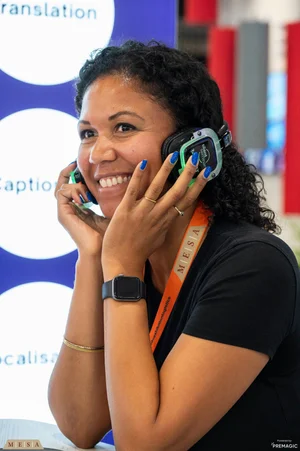
Our founder and CEO, Julia Danmeri, recently joined James Dickson on the Event Industry News Podcast to talk about the role language plays in the events industry, and why it's so often taken for granted.
They covered translation, in-person and remote interpreting, sign language, captioning and localisation, as well as where technology fits in and where the human touch still matters most. Here are a few highlights.
Built on 20 years in event operations
Julia studied languages at university and found her way into events almost by chance. Over 20 years in event operations, she used her languages to run events, negotiate contracts and work client side with translators and interpreters, and it was that experience that led her to found TranslateAble.
It's also why we offer the full range of language services under one roof. "Your to-do list is really long," Julia explained, "so if you can have one supplier rather than three, that makes life so much easier." It means organisers can compare options side by side, including different price points, because as Julia put it, "Not everyone has an all-singing, all-dancing budget."
"Everyone speaks English" isn't quite true
Julia pointed out that many attendees don't have English as their first language, including those whose first language is sign language, and that even confident English speakers may not feel comfortable joining in a conversation in their second language.
She also shared a lighter example from an event in France. After waiting some time for an electrical cable to be moved, she asked an electrician for help in French, and he told her that because she'd asked in French, he'd do it straight away.
Localisation came up too. James recalled a US trade show where a stand became a booth, and Julia explained that we keep glossaries of event terminology, from shell scheme to space only, in UK English, US English and every language we translate into, because these terms are second nature to event professionals but not always to translators.
Technology and the human touch
Julia described our approach to technology as platform agnostic. We don't own an AI captioning tool, but we keep up to date with what's available so we can recommend the right one for each brief, sometimes alongside human captioners or interpreters.
She was candid that AI has made language services more accessible for many events, but her hope is that organisers plan them in from the start rather than adding them at the last minute. And some moments will always need people. "If you're an exhibitor on a stand, you need to interact with the visitor standing right in front of you. You're going to want a person there."
Listen to the full episode
Our thanks to James and the Event Industry News team for having Julia on the podcast, and to Present Communications for sponsoring the episode. You can listen to the full conversation here.
If the episode has you thinking about language or accessibility at your next event, do get in touch. We'd be very happy to help.